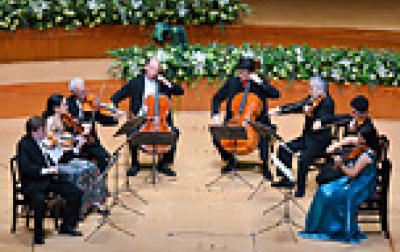
| Stradivarius " Paganini Quartet " |
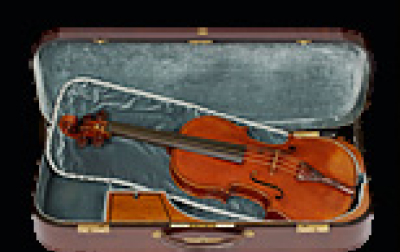
 1727 violin (1st violin), 1680 violin (2nd violin), 1731 viola, 1736 cello This is one of the only six sets of quartet compiled with instruments made by Antonio Stradivari (1644-1737) known to exist today. All the instruments of this particular quartet were once owned by the Italian virtuoso violinist and composer, Niccolo Paganini (1782-1840). Nippon Music Foundation acquired this quartet from the Corcoran Gallery of Arts in Washington, D.C. in 1994 and loans them as a set. |
 |
| Stradivarius 1700 violin " Dragonetti " |
 This violin is one of the very few instruments which still retain its original neck. Its name is taken from the owner, Domenico Dragonetti (1763-1846), who was an Italian virtuoso double bass player. Dragonetti formed a large collection of double basses, violins, cellos, harps and guitars. Just prior to the Foundation's acquisition, this violin was played by the renowned violinist, Frank Peter Zimmermann (1965- ) throughout the world. |
 |
| Stradivarius 1702 violin " Lord Newlands " |
 This violin was named after the owner, Lord Newlands (1890-1929), who treasured it throughout his life. While this violin was in the care of W.E.Hill & Sons of London between 1964 and 1982, it was exhibited at the CINOA Exhibit of Bath in 1973 as the most outstanding violin in the Hill Collection. According to the world virtuoso violinist Isaac Stern (1920-2001) who once played this violin, "Lord Newlands" has the same power as his "del Gesu" violins. |
 |
| Stradivarius 1708 violin " Huggins " |
 The name of this violin is taken from the ownership by Sir William Huggins (1824-1910), an English astronomer who bought it from the Emperor of Austria via W.E. Hill & Sons around 1880. In 1997 Nippon Music Foundation started to loan this violin to the first-prize winners of The Queen Elisabeth International Music Competition in Belgium in order to support the Competition and the young promising players. The previous winners of the competition are Nikolaj Znaider, Baiba Skride, Sergey Khachatryan, Ray Chen and Andrey Baranov. |
 |
| Stradivarius 1709 violin " Engleman " |
 This violin was once owned by the family of a naval officer Commander Young until his death in the World War II. The Young family had retained possession of the violin for almost 150 years, which is reflected in its superior condition. Nippon Music Foundation acquired this violin from an American amateur violinist and collector Ephraim Engleman, hence the name "Engleman". |
 |
| Stradivarius 1710 violin " Camposelice " |
 The name of this violin is derived from the owner in France in the 1880s by the name of Duke of Camposelice, who was a well-known Stradivaius collector. In 1937, this violin was exhibited at the prestigious Cremona Exhibition by Dr. Kuhne who owned a collection of instruments. It was in the hands of a Belgian amateur player who kept it for over 30 years and it is from his family that Nippon Music Foundation acquired this instrument. |
 |
| Stradivarius 1714 violin " Dolphin " |
 This violin is perhaps one of the most famous violins known today. It is recognized as one of the top three violins made by Stradivari along with 1715 gAlardh and 1716 "Messiah". This instrument was once owned and played by the world famous virtuoso Jascha Heifetz (1901-1987). The owner in the late 1800s, George Hart, who was an instrument dealer in London, named the violin gDolphinh as its striking appearance and colour of its back reminded him of a dolphin. |
 |
| Stradivarius 1715 violin " Joachim " |
 This is one of the five 1715 violins once owned by the famed Hungarian violinist, Joseph Joachim (1831-1907). This violin was later bequeathed to Joachim's great-niece Adela d'Aranyi, who was a violinist and a pupil of Joachim. Therefore, the violin is also known as "Joachim-Aranyi". This violin had since remained in the Aranyi family until Nippon Music Foundation acquired the instrument. |
 |
| Stradivarius 1716 violin " Booth " |
 The name "Booth" comes from Mrs. Booth, an English lady. She purchased the violin about 1855 to form a quartet of Stradivari instruments for her two sons who showed considerable talent when young. In 1931, the violin passed into the hands of Mischa Mischakoff (1896-1981), a celebrated American violinist, and in 1961, the violin became a part of the Hottinger Collection in New York. The violin enjoys a very good reputation for excellent quality of tone and power and good state of preservation. The Foundation acquired this violin in 1999. |
 |
| Stradivarius 1717 violin " Sasserno " |
 The name of this violin is taken from a French owner in 1845, Comte de Sasserno. In 1894, it was acquired by a violinist Otto Peiniger, who in turn sold it to Pickering Phipps, owner of a well-known brewery in England. In 1906, this violin was passed into the hands of an English industrialist John Summers and was well-preserved in his family over 90 years. |
 |
| Stradivarius 1722 violin " Jupiter " |
 This violin has been in caring hands who appreciated its quality, and therefore it is a well-preserved example of Stradivari's work. It is believed that a great English collector James Goding named the violin "Jupiter" in the early 1800s. For a period of time, this instrument was played by Midori Goto before the Foundation's acquisition. |
 |
| Stradivarius 1725 violin " Wilhelmj " |
 The name of this violin is derived from a German violinist August Wilhelmj (1845-1908), who came to possess this instrument in 1866. This violin was Wilhelmj's favorite among many precious violins he owned. After 30 years of playing this instrument, Wilhelmj passed this violin on to his pupil in America as he made the decision to "quit when at my best". |
 |
| Stradivarius 1736 violin " Muntz " |
 The label attached to this instrument bears an Italian inscription, "d'anni 92 (92 years old)", handwritten by Stradivari himself. It has a first class reputation for its excellent condition and tonal quality. This violin takes its name from a famous collector and amateur violinist, H.M.Muntz of Birmingham, England, who owned this violin in the late 1800s. This is one of the last instruments made by Stradivari, who passed away in 1737. |
 |
| Stradivarius 1696 cello "Lord Aylesford" |
 This cello was once owned by a well-known amateur player, Lord Aylesford of England, hence its name "Lord Aylesford". Lord Aylesford acquired this cello in early 1780s from the famous Italian violinist Felice de Giardini (1716-1796) and it was retained in the Aylesford family for almost 100 years. In 1946 this cello passed into the hands of the world renowned cellist Gregor Piatigorsky (1903-1976) in Philadelphia, USA. During the years between 1950 and 1965, internationally acclaimed cellist, Janos Starker (1924- ), played this cello in numerous concerts and made 35 recordings. |
 |
| Stradivarius 1730 cello " Feuermann " |
 This cello is known for its relatively slim body. From 1934, it was owned by Emmanuel Feuermann (1902-1942), one of the greatest cellists in the world and is also well known in Japan as the teacher of Hideo Saito. Feuermann performed throughout the world and recorded with this cello, hence the name "Feuermann". |
 |
| Guarneri del Gesu 1736 violin " Muntz " |
 This violin was made by Bartolomeo Giuseppe Guarneri (1698-1744), a distinguished violinmaker comparable to Stradivari. This violin is also known as "Muntz" from its ownership by the same Muntz family as the 1736 Stradivarius violin. Since Nippon Music Foundation owns two "Muntz" violins both made in 1736, the Foundation holds duo recitals to compare the sounds of the two instruments. |
 |
| Guarneri del Gesu 1740 violin "Ysaye" |
 This violin bears the name "Ysaye" from the Belgian violinist Eugene Ysaye (1858-1931). Inside the violin is an inscription written in French with red ink, "This Del Gesu was the faithful companion of my career. Ysaye 1928". The violin took part in the procession of Ysaye's State funeral being carried on a pillow in front of the virtuoso's coffin. From 1965, the violin was owned by the world virtuoso violinist Isaac Stern (1920-2001), from whom Nippon Music Foundation acquired in 1998. |
 |
| Photo by S. Yokoyama |
 |